Overview
A personally identifiable information (PII) data privacy vault safeguards PII from unauthorized access and cyber threats, ensuring data security and compliance with privacy laws. It stores PII in an isolated, tightly controlled system. And every other system holds tokens in place of the real values, so a breach outside the vault can expose only tokens, not raw PII. Where the vault holds the token map, only authorized users and processes can swap a token for the original value, and every exchange is logged. The design helps organizations protect personal data and meet data privacy obligations, while still using that data for operations, analytics, and AI.
Key takeaways
- Securing PII data starts before the vault: find and classify PII, collect less of it, and delete it once its purpose ends
- Tokens can flow into data warehouses, analytics, and AI pipelines, so teams can join and analyze customer data without exposing who the customers are
How a data privacy vault protects sensitive data
A data privacy vault is a data security control engineered to isolate sensitive data, effectively mitigating uncontrolled data growth.
Security within a data privacy vault is fortified through advanced encryption and tokenization techniques. Encryption ensures that data, both at rest and in transit, is rendered unreadable to unauthorized users. While tokenization replaces sensitive data elements with nonsensitive equivalents.
Access to a data privacy vault is tightly controlled through the implementation of zero trust architecture and role-based access control (RBAC), or attribute-based access control (ABAC) models.
Monitoring capabilities within a data privacy vault are enhanced through robust audit logging. These capabilities allow for the tracking of all access and modifications to sensitive data, providing a comprehensive overview of data interactions.
Data privacy vault vs. other kinds of vaults
Three other "vaults" share a similar name but solve different problems:
- Data vault modeling: A method for designing data warehouse schemas from hubs, links, and satellites. It organizes historical data; it does not protect PII.
- Secrets managers: Store credentials, API keys, and encryption keys for applications and infrastructure. A privacy vault may rely on one for its keys, but it stores and governs the personal data itself.
- Personal or consumer vaults: Apps where individuals keep their own documents and photos. An enterprise data privacy vault protects the PII an organization holds about its customers, patients, and employees.
What counts as PII?
A vault can only protect the PII you’ve identified, so accurate classification is the first step.
Data privacy laws use many different definitions to delineate personal data or personally identifiable information (PII). But in general, it can be defined as encompassing any data that can be used alone or in conjunction with other information to uniquely identify, contact, or locate a single living person. This information includes, but is not limited to, names, addresses, social security numbers, and financial records.
Unauthorized access to PII can lead to identity theft, financial fraud, and severe legal penalties. Organizations must securely manage all forms of PII across data warehouses and customer data platforms to maintain compliance and customer trust.
Direct, indirect, and sensitive PII
- Direct identifiers identify a person on their own: Full name, social security number, passport or driver’s license number, email address, phone number.
- Indirect (quasi-) identifiers identify a person only in combination: Date of birth, ZIP code, gender, job title, device ID. A table with no names can still identify people if enough of these fields sit together.
- Sensitive PII causes serious harm if exposed: Financial account and card numbers, health records, biometrics, precise location. Most vault designs start with these fields and the direct identifiers.
How does a data privacy vault work?
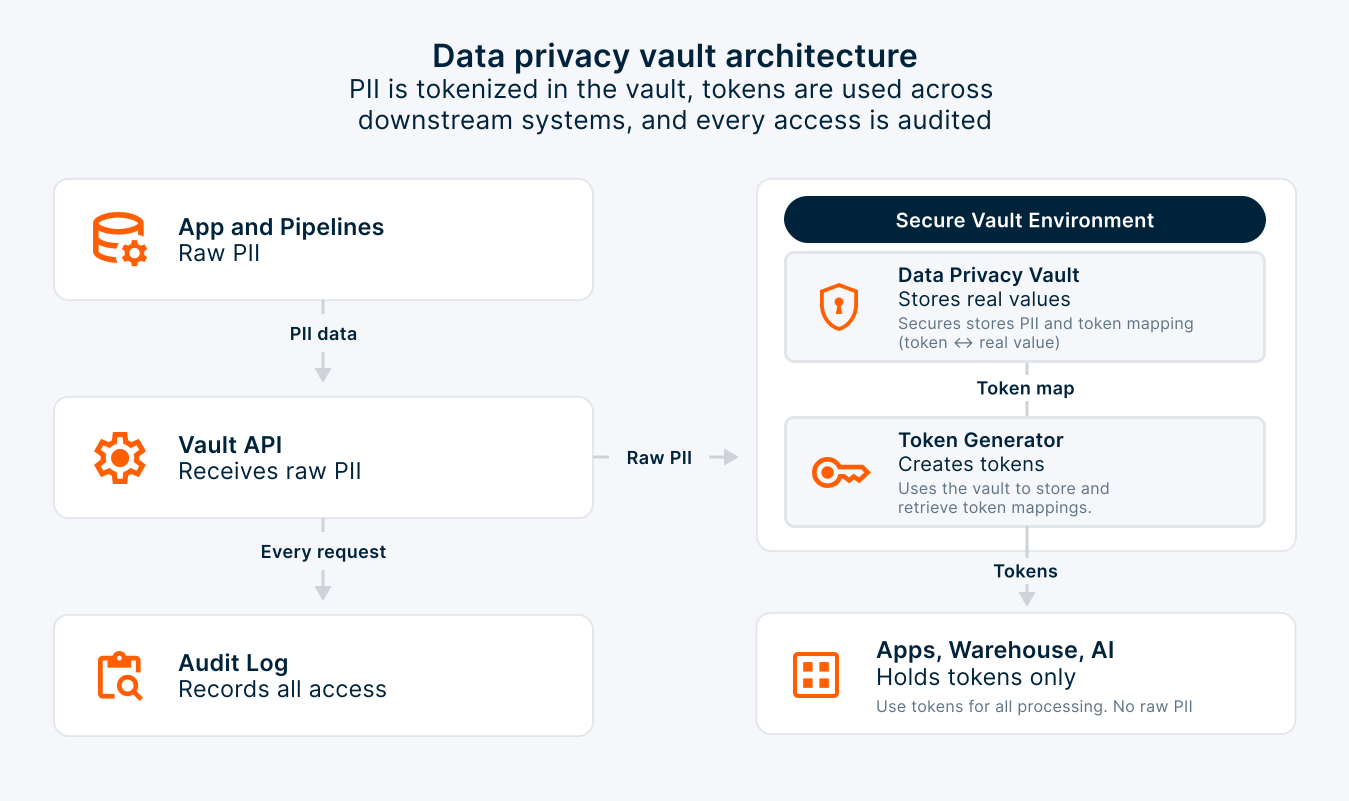
A data privacy vault sits between the systems that collect PII and those that use it. A typical architecture executes six steps:
- An application or data pipeline collects PII, such as a customer’s name and card number, and sends the sensitive fields straight to the vault.
- The vault tokenizes and stores the PII. It encrypts and holds the real values and returns a token for each one—a substitute value with no exploitable meaning—often in the same format as the original.
- Other systems, including application databases, logs, data warehouses, and AI pipelines, store the tokens instead of real values. Joins, counts, and most analytics run on those tokens, so raw PII is never exposed.
- The vault returns real values only when its access rules allow it. When a person or service needs the original value, such as a support agent confirming the last four digits of a card, it sends the token to the vault. The vault checks who is asking, their role, and why they need it. Depending on the rules, it returns the full value, a masked value, or nothing.
- The vault also logs every request, recording who asked for which field, when, and why, which gives security and privacy teams one audit trail for all PII access.
- Retention, deletion, and data residency rules are set and enforced in one place. With vault-based tokenization, deleting a customer’s record from the vault means the tokens in downstream systems no longer point to anything. Those systems keep only meaningless tokens, and the customer’s real data is gone.
Tokenization vs. encryption vs. masking
Vaults use all three techniques, for different purposes:
| Tokenization | Encryption | Masking | |
|---|---|---|---|
| What it does | Replaces a value with a substitute token | Scrambles a value with a cryptographic key | Hides part or all of a value when it is displayed or copied |
| Reversible? | Yes, only through the vault or tokenization service | Yes, by anyone holding the key | Usually not (static masking); dynamic masking hides values at query time |
| Format | Can keep the original format and length | Ciphertext; format changes unless format-preserving encryption is used | Keeps the format, such as XXX-XX-6789 |
| Best for | Using PII in apps, analytics, and AI without exposing it | Protecting stored and transmitted data | Showing just enough to users, and test or development copies |
| Where the secret lives | The vault’s token map, or keys in vaultless tokenization | The key management system | The masking rules and policies |
Features of a data privacy vault for PII protection
A data privacy vault for PII protection is equipped with a suite of robust features to safeguard sensitive information effectively. Here's a detailed look at the primary features that fortify the security of such a vault.
Encryption: PII is encrypted both at rest and in transit
Vaults encrypt personal information at rest and in transit, keeping data securely encoded and inaccessible to unauthorized parties.
Access controls: Multifactor authentication and role-based access control (RBAC)
Multi-factor authentication (MFA) and role-based access control (RBAC) restrict system access strictly to authorized users based on their roles, minimizing the risk of data breaches.
Exposure mitigation: Data masking and tokenization
Data masking obscures specific fields from unauthorized view, while tokenization replaces sensitive elements with nonsensitive equivalents to protect personal information during a breach.
Audit trails: Detailed audits and tracking of data handling activities
Audit trails provide a detailed record of data handling activities, enabling organizations to track changes, verify access, and respond to security incidents.
Many organizations must keep audit logs. For example, the HIPAA Security Rule requires audit controls for systems that contain or use electronic protected health information, and PCI DSS Requirement 10 requires logging and monitoring of all access to system components and cardholder data.
Monitoring and alerts: Real-time alerts for suspicious activities or policy violations
Real-time monitoring provides immediate notifications of unusual activities or policy violations, allowing organizations to promptly detect and address potential threats.
How to secure PII data: Four practices
A vault is one control in a wider PII protection program. These four practices apply whether or not PII sits in a vault:
- Find and label: Scan databases, files, and logs to find where PII lives, then label each field by sensitivity. Classification is the foundation of data governance and decides what goes into the vault.
- Collect less: Collect only the fields a purpose needs, and set retention periods. Data that was never collected cannot be breached.
- Replace identifiers: Swap names, account numbers, and IDs for tokens or pseudonyms. NIST describes this as replacing direct identifiers with values such as randomly generated ones.
- Manage location and deletion: Track data residency requirements, delete PII when its purpose ends, and document the program in a data privacy framework.
Protecting PII in databases and data warehouses
Most PII ends up in a database, first in the application that collected it, then in the data warehouse and lakehouse where it is joined with everything else for data analytics. That second copy is where exposure grows, because a warehouse serves many teams, tools, and now AI agents. A PII database design that works with a vault follows three rules: load tokens instead of raw PII wherever analysis does not need the real value; use the same token for the same value, so customer records still join across tables; and keep detokenization rare, logged, and limited to named roles.
The Teradata Autonomous Knowledge Platform supports row-level security, which can be combined with column-level security, so the warehouse itself enforces who sees which rows and fields.
Vault-based vs. vaultless tokenization
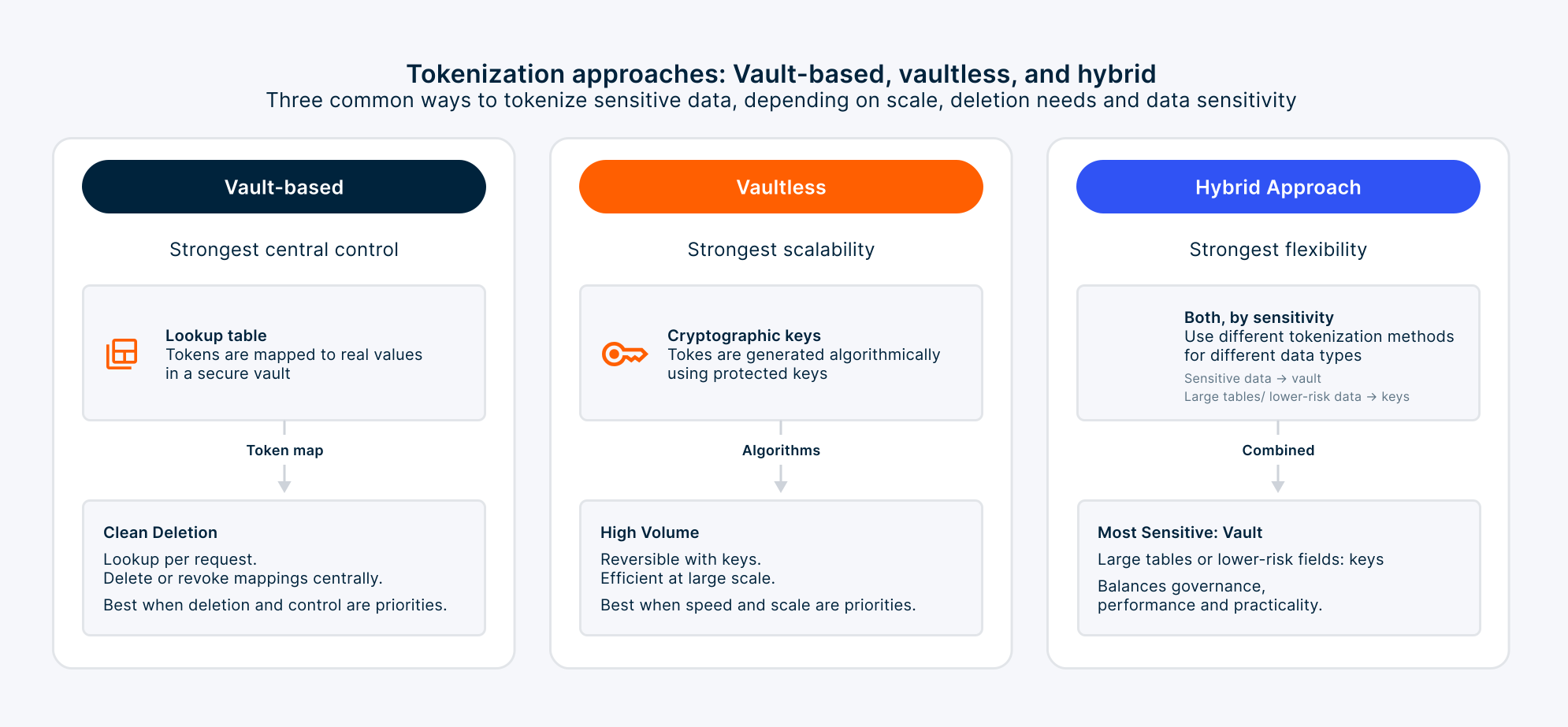
In vault-based tokenization, the vault keeps a lookup table that maps each token to its original value. This approach is easy to understand and audit, because every real value is stored in one place. It also makes deletion straightforward: remove the entry, and the token is useless. The tradeoff is that every detokenization requires a lookup in the vault, and the table holding the real values must be secured and scaled as data grows. Vaultless tokenization avoids the lookup table. It generates tokens with cryptographic algorithms and keys, so tokens can be created and reversed anywhere the keys are available. That suits high-volume warehouse workloads. Some organizations use both: a vault for the most sensitive identifiers and vaultless tokenization for large analytic tables.
PII in analytics and AI pipelines
AI raises the stakes because models and agents can repeat what they see. Tokenized data lets data scientists train and test models on realistic records without seeing who the records describe. For generative AI, retrieval-augmented generation (RAG) keeps sensitive data in governed stores and retrieves only what a permitted user may see at query time, instead of training it into a model. In 2025, Germany's Datenschutzkonferenz (DSK) concluded that RAG can also have a significant positive impact on privacy compliance.
Tokenization does not take data out of privacy law. Under the GDPR, tokenization can be treated as pseudonymization: it reduces risk, but tokenized data that the vault can re-identify is still personal data. Draft European Data Protection Board guidelines (January 2025) stress that the information needed to re-identify people must be held separately and securely, which is exactly the role a vault plays.
See how Teradata approached securing PII data for a North American retailer.
Benefits of using a data privacy vault for PII
Vaults safeguard sensitive information against cyber threats using advanced encryption and strict access controls. Built-in data masking, tokenization, and audit trails also streamline compliance with complex regulations like the GDPR to protect against legal penalties.
By securing information through encryption and access controls, vaults prevent unauthorized modifications and ensure data remains accurate.
Centralizing the storage of sensitive data streamlines data handling, improves team collaboration, and mitigates the risk of uncontrolled data growth.
Secure your data. Build trust.
Modern business is deeply interconnected, creating both opportunities and risks. Teradata safeguards data with best-in-class technologies and processes, earning the trust of leading enterprises from the world’s most highly regulated industries. To learn more about how Teradata delivers trusted data for business, visit our Trust and Security Center.
And explore how the Teradata Autonomous Knowledge Platform can help you govern sensitive data where it lives.
This content is for information-only purposes. The content isn’t intended to constitute legal advice and shouldn’t be relied on as such. Organizations should consider the content based on their individual circumstances. Teradata recommends customers take their own independent professional advice on the matters contained in this document.
Frequently asked questions
Does PII data need to be encrypted?
Does PII data need to be encrypted?
Encrypting PII at rest and in transit is a baseline control in security frameworks such as NIST SP 800-53, and PCI DSS sets explicit requirements for protecting stored and transmitted cardholder data. Whether a specific law requires it varies by jurisdiction and data type, so confirm the position with your legal team.
How is a data privacy vault different from a data clean room?
How is a data privacy vault different from a data clean room?
A data privacy vault protects one organization’s PII by isolating and tokenizing it, while a data clean room lets several organizations analyze combined data without exchanging raw records. They solve different problems, and a clean room does not protect privacy on its own. The US Federal Trade Commission cautioned in 2024 that privacy-enhancing technologies alone cannot guarantee privacy.
How should you store PII data in a database?
How should you store PII data in a database?
Keep direct identifiers in a vault or tokenized columns and encrypt the remainder at rest. Keep raw PII out of logs, test environments, and analytics copies.
Is the GDPR still relevant for PII protection?
Is the GDPR still relevant for PII protection?
Yes. The European Data Protection Board published draft guidelines on pseudonymization under the GDPR in January 2025, so EU regulators are still issuing GDPR guidance on how personal data is protected.
Can a PII data privacy vault be hacked?
Can a PII data privacy vault be hacked?
Any system that holds sensitive data can be attacked, so the vault and the data it replaces must be protected A vault limits what a breach elsewhere can expose, because other systems hold only tokens, and it protects the stored values with encryption, multifactor authentication, role-based access control, and audit logs of every request.